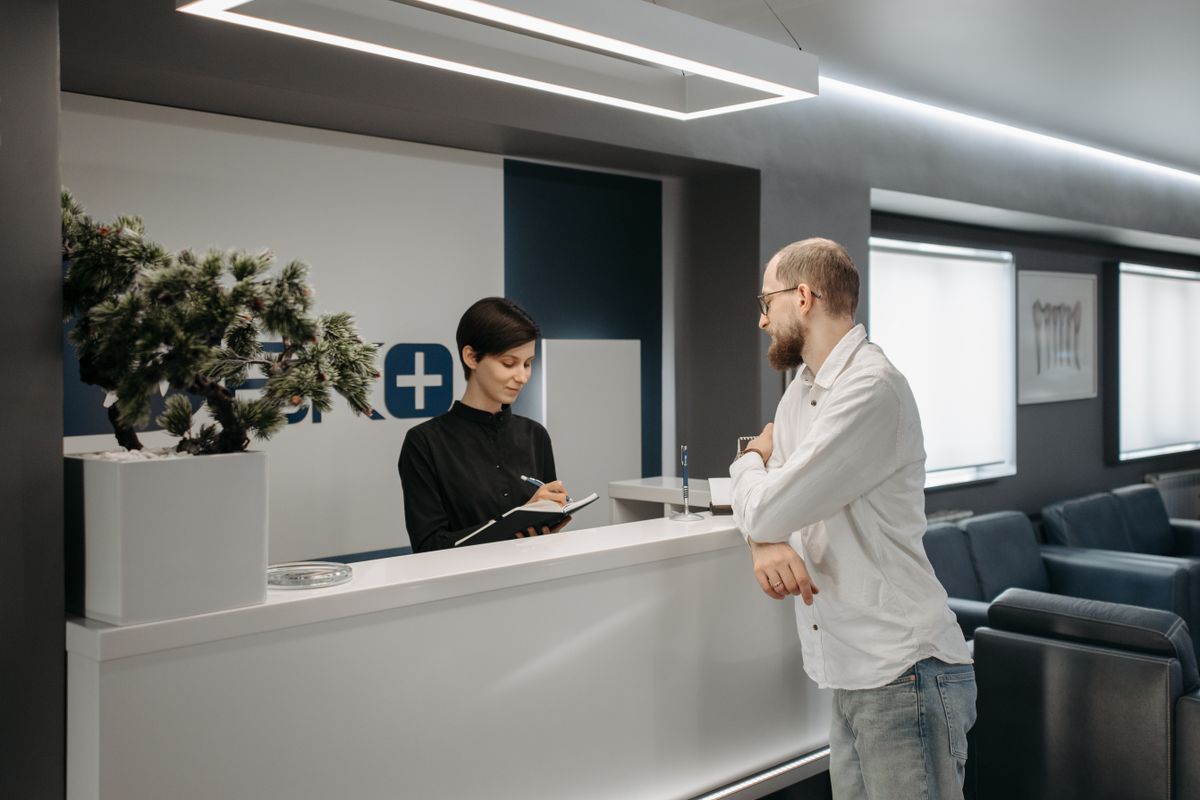
Ask a practice owner where their front desk time goes and most will shrug and say the phone. They are not wrong. What surprises them is how much of the day it really is, and how little of it needs a human at all.
A front desk is supposed to be the face of your practice. The warm hello, the person who makes a nervous new patient feel at ease. Instead, a big chunk of the shift gets spent as a human switchboard, reading the same open slots out loud and typing the same appointment into the same calendar, over and over. That is not a people problem. It is a setup problem, and it is costing you on both ends: the staff you pay and the patients you never book.
First, the honest number
Scheduling by phone eats more of the day than it feels like. Industry analyses of practice call data estimate the average office handles dozens of scheduling related calls per provider every day, and once you add hold time each one runs about four minutes. Stack those up and you are looking at several hours of staff labor per provider, every single day, spent only on booking, rescheduling, and confirming visits. Some estimates put phone scheduling at close to 38 percent of total front desk time.
Sit with that for a second. More than a third of the day your front desk is paid for, gone to a task that mostly repeats itself. Now add the part that never shows up in a time study: the patient standing at the counter who waits because the person who should greet them is stuck on hold with an insurance line, or the walk in who watches your receptionist juggle two calls and decides your office feels chaotic before anyone has said a word.
The strange part: your patients would rather do it themselves
Here is what makes the phone pile up so frustrating. Most patients do not want to call you. Surveys keep landing in the same place: roughly two thirds of patients say they would prefer to book online, and about 40 percent of online bookings happen after the office has closed for the day, at 9pm on the couch with the kids finally down.
So the demand to self book is clearly there. The adoption is not. A 2024 MGMA Stat poll of 318 practice leaders found that 73 percent said a quarter or fewer of their patients use digital tools to schedule. Only 11 percent said a majority of their patients book online. Read those two numbers together and the picture is clear: patients want a button, and most practices are still handing them a phone number.
Why the gap? Usually not because the practice refuses to offer online booking. It is because booking online is the hard option, not the easy one. The link is buried three clicks deep in a menu. The form asks for a dozen fields and an insurance card before it will show a single time. It does not show real openings, so the patient fills everything out and then waits for a callback anyway. Faced with that, people give up and dial, because the phone, as annoying as it is, actually works. We dug into this exact drop off in why patients do not use online scheduling.
The cost nobody puts in the budget: the calls you miss
Staff hours are only half the bill. The other half is the calls that never get answered at all. When every booking has to go through one or two people, the lines back up, and a share of patients hit a busy signal, a hold they abandon, or voicemail.
Industry benchmarks commonly put unanswered calls at a typical practice somewhere around 20 to 30 percent during business hours. After hours, with voicemail as the only option, it is basically all of them. And missed calls do not politely wait for you to call back. Most people will not even leave a message, and a large share simply dial the next practice on the Google results. We wrote about this leak in how the front desk loses patients on the phone, and the pattern is always the same: the patient was ready to book, you just were not there to pick up.
Think about what that call was worth. A new patient is not a 40 dollar transaction. Depending on your specialty, one new patient can be worth thousands over the life of the relationship. A front desk so buried in routine scheduling that it drops one new patient call a day is not saving you money by skipping a hire. It is slowly bleeding the most valuable thing you have.
So the goal is not a bigger front desk. It is a lighter phone.
The instinct when the phones are chaos is to hire another person to answer them. Sometimes you do need more hands. But throwing a body at a repetitive task you could automate is the expensive way to solve it, and in a tight labor market you may not find the body at all. The smarter move is to take work off the phone, not add people to it. Three things do that.
1. Make online booking the easy default, not a scavenger hunt
If you want patients to self book, booking has to be the path of least resistance. That means a clear Book Appointment button at the top of every page, not a link hidden under a menu. It means real openings the patient can pick in a few taps, a short form that does not demand their life story up front, and the same button right on your Google Business Profile so patients can book without even visiting your site. When online booking is faster than calling, patients choose it, and your phone volume drops on its own. A website built to convert treats booking as the main job of the page, not an afterthought.
2. Catch the calls you cannot answer, around the clock
Even with great online booking, some people will always call, and the phone will still spike at lunch, on Monday mornings, and after you close. That overflow is exactly where patients slip away. This is where an AI receptionist earns its keep. It answers new calls and texts in seconds, any hour, so a patient who reaches out at 8pm gets booked instead of a voicemail greeting. It handles the routine questions, hours, location, do you take my insurance, without tying up a human, and it texts people back the moment they fill out a form, while they are still interested. It does not replace your front desk. It covers the volume your front desk physically cannot.
3. Point the freed up hours at patients, not the calendar
Here is the payoff most owners miss. When you pull routine scheduling off your team, you do not just save money, you free your best people to do the work that actually grows the practice. Greeting patients warmly so they leave a five star review. Following up on treatment plans people meant to book and forgot. Reaching back out to past patients who drifted away, which is the cheapest growth any practice has. The phone was never the valuable work. It was just the loudest.
How EtherealMinds puts this together
We are a healthcare only growth agency, and this is one of the first leaks we look for, because it is usually hiding in plain sight. A practice is spending on ads to make the phone ring, then losing a chunk of those calls to a front desk that is already maxed out. You are paying twice: once to generate the call, again when it goes unanswered.
When we build a practice's patient acquisition system, we do not stop at bringing in the inquiry. We fix the handoff. That means a fast site where booking is the obvious action, an AI receptionist covering the phones and texts day and night so nothing goes to voicemail, and automated reminders and reactivation running in the background so your team is not doing it by hand. The marketing fills the top of the funnel. The system makes sure the people you paid to reach actually land on your calendar instead of your competitor's.
Our honest take
Your front desk is too good to spend a third of the day reading appointment slots out loud. That person is the first human a patient meets, the one who can turn a nervous caller into a loyal one. Burying them under routine phone scheduling wastes them, frustrates patients who would rather book online anyway, and silently loses the calls that never get picked up.
The fix is not more phones or more staff. It is less phone. Make self booking the easy default, cover the overflow with a responder that never sleeps, and let your people do the work only people can do. Do that and the schedule fills tighter, the lobby feels calmer, and the patient standing at your counter finally gets the hello they came in for.
Give your front desk its day back
Book a free strategy call. We will look at how your patients book today, where calls are getting missed, and how to move routine scheduling off the phone so your team spends its time on patients, not voicemail. No pressure, just a clear picture of what it is costing you and what to fix first.
Book a free strategy call →